Why Is Process Street the Best for Form Building?
Many teams spend hours recreating the same compliance checklists across Docs, Ops, and Cora because their current form builder does not connect the pieces. This gap leaves policy updates scattered and audit evidence incomplete. The result is lost time and repeated manual checks whenever new regulations appear.
After reading this article you will see exactly how Process Street's form builder handles version control, workflow triggers, and risk scoring in one place. You will know which plan matches your audit frequency and security requirements. You will also clarify whether your organization needs the automation that Ops and Cora provide or whether Docs alone is enough.
What Is Process Street?
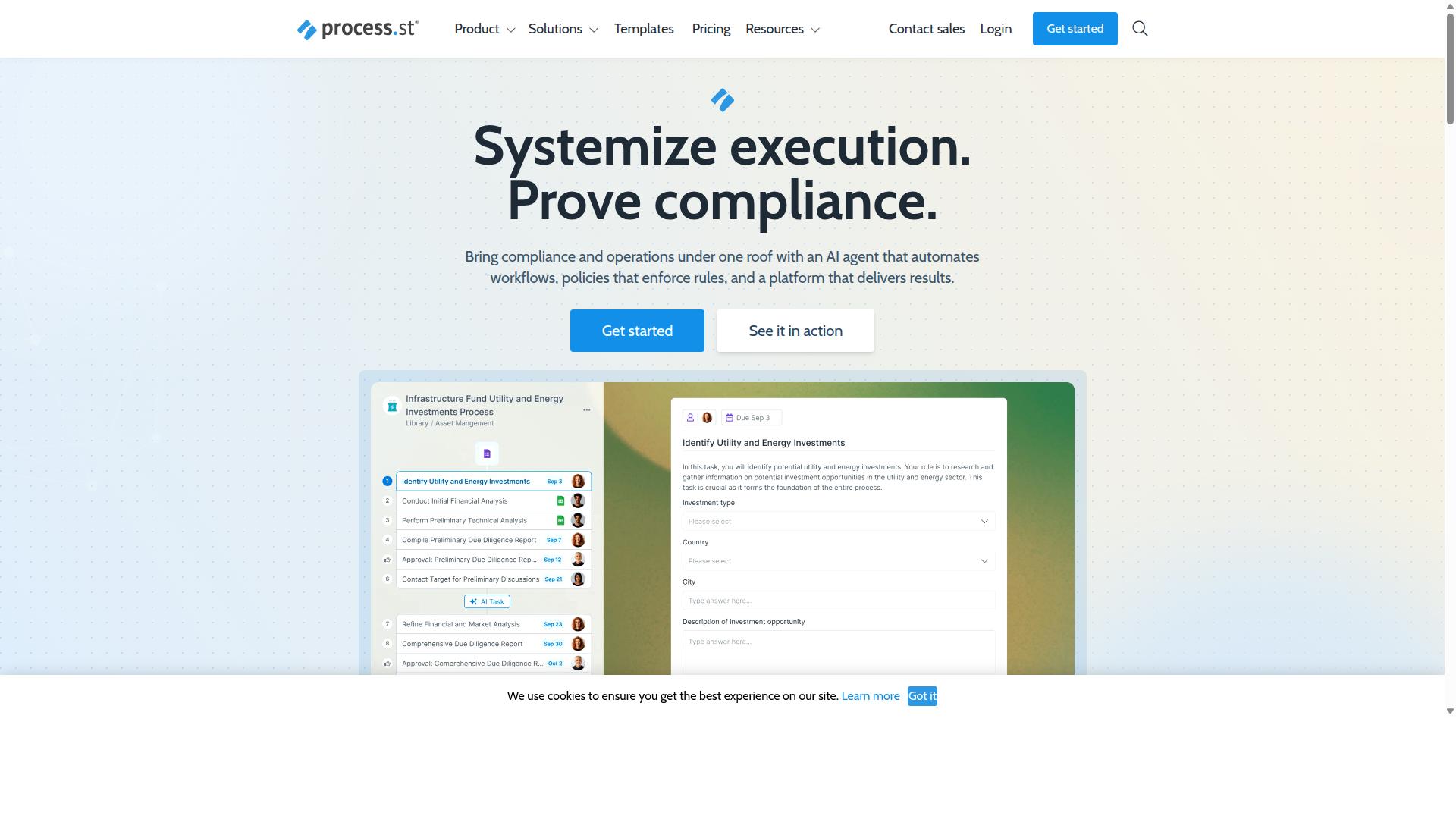
Process Street is a compliance operations platform that automates business processes and enforces policies across organizations. The platform serves teams that need more than basic form tools. It delivers structured workflows that stay audit ready at every step.
Many organizations rely on Process Street to standardize operations and prove compliance. The platform stands apart from simple form builders because it connects document control with live process execution. Users move from static data collection to active, trackable workflows.
The platform includes three main products. Docs handles document management and policy control. Ops manages workflow automation and process orchestration. Cora acts as an AI compliance and risk agent that supports ongoing oversight.
Traditional form tools often stop at data entry. Process Street extends each form into an automated sequence that includes task assignments, approval steps, and audit trails. This shift turns a single submission into a complete, trackable workflow.
Teams that need both data collection and process enforcement find Process Street useful. The platform maintains consistency while reducing manual handoffs between departments. Every record stays connected to the policies that govern it.
Why Process Street Is the Best for Form Building
Process Street combines drag-and-drop form creation with conditional logic and reusable templates to handle complex compliance needs. The platform helps organizations build forms that adapt to different scenarios while maintaining consistent data collection standards. Companies use these capabilities to standardize processes across departments.
Conditional logic reduces manual follow-ups by showing or hiding form fields based on previous answers. This means users only see questions that apply to their specific situation. Teams spend less time chasing incomplete responses or clarifying information that was already covered in earlier sections.
Template reuse cuts setup time. Organizations can duplicate proven form structures instead of building each document from scratch. This approach ensures consistency while accelerating the form creation process across multiple projects and teams.
The drag-and-drop interface eliminates the need for developers. Users arrange form fields, set validation rules, and configure conditional logic through visual controls. This design enables business teams to create and modify forms without waiting for technical resources or learning programming languages.
Process Street serves over 3,000 companies and more than one million users worldwide. The platform maintains SOC 2 Type II certification, ISO 27001 compliance, and HIPAA standards. These security measures protect sensitive form data while organizations handle everything from employee onboarding to vendor assessments.
Key Features and What Makes Process Street Stand Out
Two distinct layers, form building and workflow orchestration, work together to deliver policy-driven automation. The form layer collects structured data through validated templates. The workflow layer routes that data into automated sequences that enforce policy and track every action.
Process Street keeps these layers separate yet connected. Form changes never break workflow logic. Workflow updates do not require form redesigns. This separation gives teams control over each piece without side effects.
Form Building Capabilities
Form design starts with a blank canvas and ends with a governed, embeddable form that enforces data quality. Process Street supports field types, conditional fields that show or hide based on answers, and multi-step wizards that guide users through complex requests.
Required-field validation prevents incomplete submissions. Version-controlled templates keep every published form aligned with current policy. Embed code lets teams place the same form on external sites without exposing the full workflow.
These capabilities make the form builder suitable for compliance-heavy environments. Document management and policy control features integrate directly with the form layer, ensuring every submission meets standards such as SOC 2 Type II and ISO 27001.
Workflow Automation and Process Orchestration
Forms feed directly into AI-powered workflows that assign tasks, trigger approvals, and log every change. Process Street routes each submission through automation paths that match common business needs.
Conditional task assignment directs work to the right person. Slack and email alerts keep teams informed without extra effort. Native Zapier sync sends data to Google Sheets for reporting. API calls connect to custom systems that require deeper integration.
One result of these automation paths is employees onboarded via automated flows. The same orchestration layer powers Ops workflows and Cora, the AI compliance agent that monitors regulations around the clock. This combination turns individual form submissions into standardized, auditable processes across the organization.
Pricing and Plans
Three tiers scale from early-stage teams to global enterprises with transparent monthly pricing. Process Street structures its plans around real workflow needs, not arbitrary feature gates.
The Startup plan gives growing teams a simplified path to professional form building. This tier includes unlimited workflows and tasks, supports up to 5 users plus 10 guests, and allows 10 automation apps with 100 automation actions per month. Teams also receive 5,000 Data Set records and 50 Public API calls per month.
Startup pricing sits below the standard Pro rate while maintaining core form builder capabilities. This plan works well for teams that need reliable data collection without enterprise complexity.
The Pro plan removes most limits to support expanding operations. Custom user and guest counts replace fixed numbers, while Data Set records extend to 10,000. Teams gain all automation apps plus custom automation actions and custom API call allowances each month.
Pro pricing reflects the added flexibility and capacity. This middle tier suits established teams running multiple approval workflows and data collection processes simultaneously.
The Enterprise plan delivers complete operational flexibility for large organizations. Custom Data Set records eliminate storage constraints while unlimited Public API access supports heavy integration demands. Dedicated Success Manager support, priority assistance, and fully-managed workflows become available at this level.
Enterprise customers also receive custom integrations, bulk document import, process consulting, health audits, and personalized team training. This tier addresses compliance requirements and scalability concerns that exceed standard plan boundaries.
Trust Signals
Enterprise security and regulatory certifications form the foundation of customer trust. Organizations evaluating form building platforms need assurance that their data remains protected while meeting industry compliance standards.
Process Street serves over 3,000 companies and 1 million users with process documentation and workflow automation needs. These numbers reflect consistent delivery of reliable solutions across diverse industries.
Trust signals help decision makers assess whether a platform meets both technical requirements and business obligations. Security certifications and documented customer outcomes provide concrete evidence of platform reliability.
Security and Compliance Certifications
Process Street holds SOC 2 Type II and ISO 27001 certifications and supports regional data residency. These credentials demonstrate commitment to industry-standard security practices and data protection protocols.
The platform maintains HIPAA compliance with BAA available upon request. Organizations handling sensitive healthcare information can request business associate agreements as needed.
GDPR and CCPA compliance address privacy requirements across multiple jurisdictions. AWS CIS compliance adds another layer of infrastructure security standards.
Role-based permission controls allow organizations to manage access according to job functions and responsibilities. Data never used to train AI models provides additional assurance about data handling practices.
ISO 9001 certification supports quality management systems. These certifications collectively satisfy requirements for FDA and SOX compliance frameworks.
Customer Success Stories
Quantified results from four named customers illustrate measurable time savings and standardization gains. Real outcomes from organizations using Process Street demonstrate practical benefits of the platform.
Alex Hauer from Salesforce reports improved process documentation efficiency. Linda White at Colliers notes enhanced technology service delivery through standardized workflows.
Diane Guy from HEALTHeLINK achieved faster documentation using Process Street templates. Joshua Ketter at Spreetail experienced measurable standardization improvements across operational processes.
Pete Watts at IMCD UK reported reduction in setup time. These documented outcomes show consistent time savings across different industry applications and use cases.
Who Should Use Process Street
Teams across six departments in regulated industries adopt Process Street to standardize daily operations.
Operations teams in financial services use Process Street for employee onboarding workflows. HR teams in real estate manage client onboarding processes. Compliance teams in manufacturing track ISO compliance requirements through structured checklists.
Customer success teams in healthcare handle document control for patient records. Finance teams in professional services maintain quality tracking procedures. IT and security teams in technology companies implement custom workflows for security protocols.
Each department benefits from Process Street's templates and task management capabilities. The platform supports role-based permissions across all six industries. Organizations maintain audit trails while handling complex approval workflows.
Process Street serves teams that need consistent processes across departments. The platform adapts to specific industry requirements without custom development. Teams in financial services, real estate, manufacturing, healthcare, professional services, and technology all find value in the standardized approach.
Final Verdict
Process Street delivers the rare combination of consumer-grade usability and enterprise-grade governance. Organizations seeking a form builder that scales from simple data collection to complex approval workflows find both the AI-powered workflow orchestration and audit-ready documentation they need in one platform.
AI-powered workflow orchestration automates repetitive steps across forms and processes. Teams set up rules once, then the system handles routing, notifications, and conditional logic without manual intervention. This reduces errors while maintaining consistency across projects of any size.
Audit-ready documentation captures every form submission, approval, and change in a single record. Compliance teams can retrieve complete histories at any time, meeting regulatory requirements without extra tools or manual tracking.
Support is available through email and chat with an average 5 minute response time and a 98 percent customer rating. Organizations can also find Process Street through the AWS Marketplace when procurement channels require it.
Teams ready to see these capabilities in their own workflows should contact sales for a personalized demo.
Recommended Resources: