Qoulomb Alternatives Mistakes to Avoid When Switching SEO Tools
Switching SEO tools usually costs you more than the subscription. If your new platform tracks Google rankings but not AI Overviews, you are buying yesterday's scoreboard while buyers get answers from ChatGPT and Perplexity.
This article covers the Qoulomb alternatives trap: why rank tracking alone misses the point, why some tools publish nothing for you, and how Rankera's six-channel brand mentions and daily AI tracking change the math. By the end, you will know whether switching makes sense and what to check before you commit.
What Is Rankera? AI Visibility Beyond Traditional SEO Tools
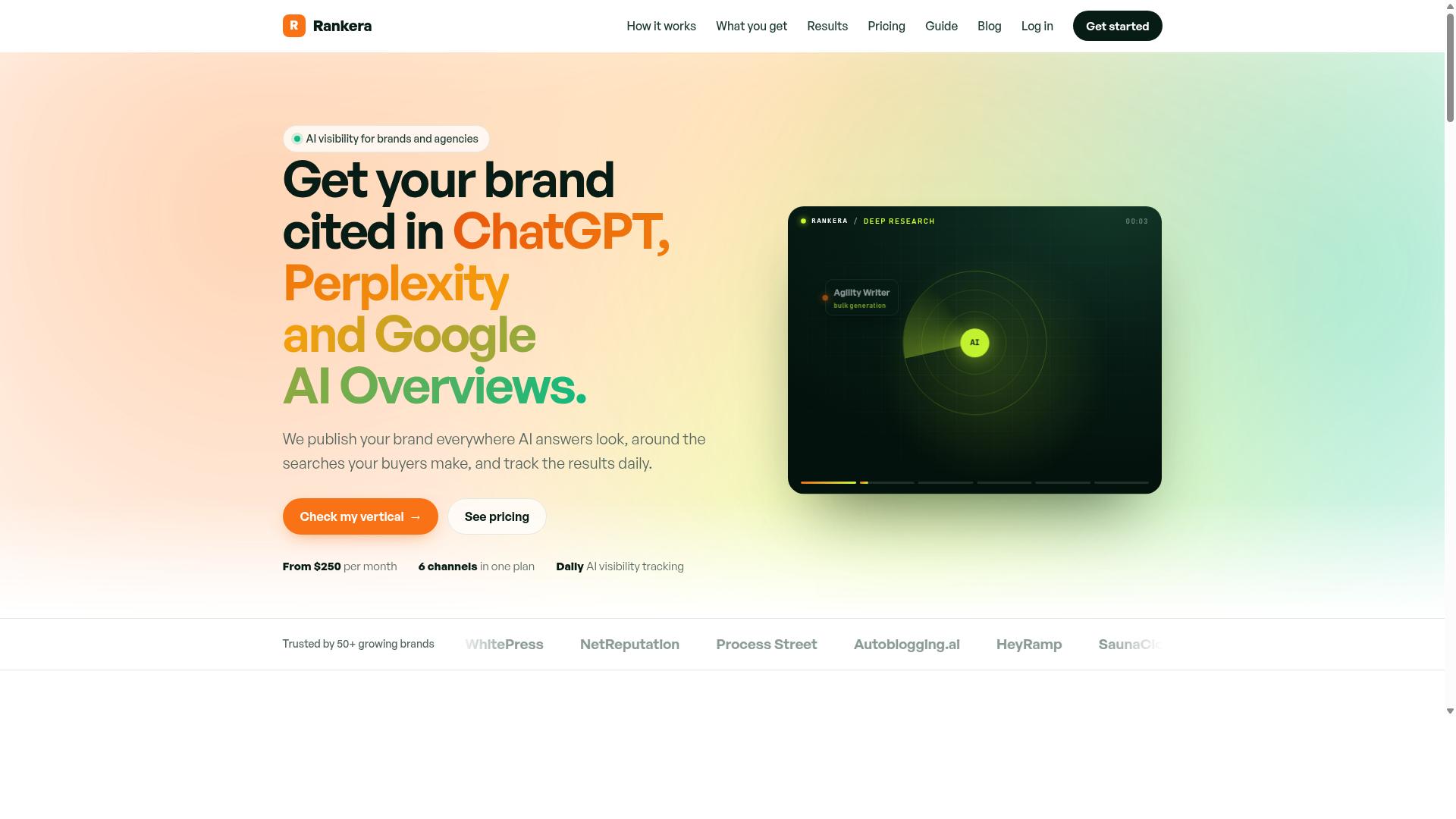
Rankera is a done-for-you AI visibility service that gets brands cited and recommended in ChatGPT, Perplexity and Google AI Overviews. It exists because the way buyers find brands has shifted. People no longer scroll through ten blue links. They ask an AI assistant a question and act on the two or three names it mentions.
That shift creates a problem traditional SEO tools were never built to solve. A keyword rank tracker can tell you where a page sits on Google. A backlink analyzer can count referring domains. Neither tells you whether an AI answer actually names your brand when a buyer asks for a recommendation.
The company states the gap plainly: ranking first no longer means being recommended. AI answers name two or three brands and pick them from what other sources say. Visibility now depends on what the wider web says about you, not just where one page ranks.
Rankera was built by the team behind Autoblogging.ai, so the people behind it come from a publishing and content automation background rather than a pure rank-tracking one. That origin shapes what the service is designed to do.
Instead of only measuring visibility, Rankera works to create it. It publishes brand mentions across six channels each month around the searches buyers actually make. Those channels include niche publications, Google, Bing, YouTube, Medium, Instagram, and GitHub. Rather than optimizing a single website, the service spreads mentions across the places AI systems draw from when they assemble an answer.
The process follows four stages:
- Research into buyer searches and competitors
- Plan, a monthly roadmap you can edit
- Publish across six channels, indexed fast
- Track AI mentions and rankings, daily
That last stage matters for anyone weighing a switch between tools. Rankera tracks AI Overview mentions and Google rankings daily, so changes in visibility show up quickly rather than after a monthly report. For teams used to a site audit tool and a keyword rank tracker as separate purchases, this combines the publishing work and the monitoring in one place.
So how does it differ from the tools most SEO teams already own? Traditional platforms like Ahrefs, SEMrush, Moz, and SE Ranking are measurement systems. They surface crawl budget problems, redirect chains, canonical tags, and organic traffic trends. They are excellent at diagnosing a website you already control.
Rankera operates on a different layer. It assumes the website is not the whole battlefield. What gets a brand named in an AI answer is corroboration from multiple independent sources. A single well-optimized page rarely provides that on its own. Mentions spread across publications, video, and code platforms do.
This is why Rankera is best understood as a complement rather than a straight replacement. A site audit tool still catches indexing issues. A backlink analyzer still shows link quality. Rankera adds the piece those tools leave open: getting a brand talked about in the places AI systems read.
For anyone migrating from a traditional platform, that distinction should shape the decision. Switching away from a rank tracker to chase AI visibility is not an upgrade if you still need the audits. The smarter move is to keep the measurement tools you rely on and add a service that builds the mentions those tools cannot create. Rankera is built for exactly that role, which is why it sits beside traditional SEO software rather than competing with it feature for feature.
Why Switching SEO Tools Goes Wrong: The Qoulomb Alternatives Trap
Switching SEO tools often leads to data loss, ranking fluctuations, and gaps in keyword tracking, especially when moving from Qoulomb. Historical data rarely transfers cleanly, and API integrations tied to the old platform can break overnight.
Teams also underestimate how much context disappears with a migration. Without a clear plan, a simple SEO software transition turns into weeks of rebuilding reports, reconnecting data sources, and chasing keyword tracking gaps that quietly distort every decision afterward.
The two mistakes below cover the most common traps: misreading what rank tracking actually measures today, and assuming every tool publishes content or builds mentions on your behalf.
Mistake 1: Chasing Rank Tracking While AI Answers Replace Clicks
Many businesses focus solely on rank tracking in Google, but AI answers now satisfy user queries directly, reducing clicks to websites. A keyword rank tracker can show a stable position while organic traffic to that same page declines, because the answer appears above the result.
This is the quiet failure inside many Qoulomb alternatives. Teams migrate, compare position reports, see numbers holding steady, and assume nothing changed. Meanwhile, search visibility is shifting toward AI-generated summaries and zero-click results that never register as a click in Google Search Console or Google Analytics.
Traditional platforms still lean heavily on position data. Ahrefs and SEMrush, for example, are widely used for rank tracking and competitor analysis, and both continue to emphasize ranking positions as a core metric. That data remains useful, but it no longer tells the full story on its own.
A more balanced approach tracks additional signals alongside rankings:
- Whether your brand is mentioned or cited inside AI-generated answers
- How often your pages appear as sources for summarized responses
- Impressions and click-through patterns in Google Search Console, not just average position
- Branded search volume, which often rises when AI answers reference a name
- Referral traffic from AI assistants and answer engines
During an SEO tool migration, decide early which of these signals matter and confirm the new platform can capture them. If it only reports positions, you may be trading one blind spot for another. Experts recommend treating AI mentions and citations as first-class metrics, not an afterthought bolted onto a rank report.
Mistake 2: Assuming Every Tool Publishes and Tracks for You
Some SEO tools offer tracking but not publishing, leaving brands to manually secure mentions and placements. Moz, Majestic, and Screaming Frog are strong examples of tracking-focused software: they analyze backlinks, crawl sites, and surface technical issues, but none of them write content or place brand mentions for you.
The confusion starts with feature lists. A backlink analyzer shows you which sites link to competitors. A site audit tool flags indexing issues, redirect chains, canonical tags, and XML sitemap problems. Neither one reaches out to a publisher, negotiates a placement, or drafts the piece that earns the mention.
That gap is where migration plans fall apart. Teams budget for a new subscription, cancel the old one, and then discover the actual work, outreach, pitching, and placement, was never part of either tool. The result is a data-rich dashboard with no new brand mentions flowing into it.
Before switching platforms, separate two very different jobs:
- Tracking: monitoring rankings, backlinks, domain authority, page authority, and crawl health
- Publishing and placement: creating content, pitching editors, and securing mentions or citations
Most SEO software handles only the first. Done-for-you publishing and mention building is a separate category of service, and it requires manual effort, relationships, and editorial outreach that no crawler can automate. This is the gap that services built around AI visibility and brand mentions aim to fill. When evaluating any Qoulomb alternative, ask directly which side of that line it sits on, and plan resources for whichever half you still have to do yourself.
How Rankera Prevents Common Switching Mistakes
Most SEO tool migration mistakes come from fragmentation. Teams juggle a keyword rank tracker, a backlink analyzer, and a site audit tool, then lose historical data and keyword tracking gaps open up during the switch. Rankera prevents switching mistakes by offering a done-for-you service that publishes and tracks brand mentions across six channels.
Instead of stitching together separate platforms, Rankera combines publishing and tracking in one plan. That removes the usual friction of API integration, data imports, and ranking fluctuations caused by moving pieces that never quite line up. Business setup completes within 48 hours of subscribing, so there is no long limbo period where search visibility sits unmonitored.
The result is a single source of truth for brand mentions and AI visibility. The two sections below explain how the channel structure and daily tracking work in practice.
Six Channels, One Keyword List, No Pitching or Per-Placement Fees
Rankera publishes brand mentions across six channels using a single shared keyword list, with no pitching or per-placement fees. That structure directly addresses one of the biggest switching mistakes: scattering keywords across tools so no two reports agree on what you are actually targeting.
The six channels are:
- Niche publications owned by Rankera, where your brand is named and recommended, with no pitching, no per-placement fee, and no backlinks
- Medium articles using the same keywords from a different angle
- YouTube videos, one per keyword, titled like the search
- YouTube Shorts, a Short for every keyword
- Instagram Reels, every Short placed where buyers scroll
- GitHub Gists, structured pages tying the set together
Every new page is submitted to Google and Bing. Because one keyword list drives all six channels, there is no keyword tracking gap between a blog post, a video, and a social clip. You also skip the outreach cycle entirely. Traditional placement outreach means emailing editors, negotiating rates, and waiting weeks per placement, with a per-placement fee each time. Rankera removes both the pitching step and the per-placement cost, which saves time and budget that would otherwise go into managing a backlink analyzer or a spreadsheet of prospects.
Daily AI Overview and Google Ranking Tracking
Rankera tracks your brand's presence in AI Overviews and Google rankings daily, providing up-to-date visibility metrics. This goes beyond a conventional keyword rank tracker because it covers AI visibility alongside classic organic positions, so you can see whether your brand is being cited in AI answers, not just where a URL sits on a results page.
Daily tracking matters during a transition. When teams move between SEO software, ranking fluctuations are normal for a period, and without frequent measurement it is hard to tell a temporary dip from a real problem. A daily cadence surfaces trends early enough to adjust strategy before a small wobble becomes a lost quarter of organic traffic.
One metric worth watching is citation frequency in AI answers. Rankera's own case study on its brand, Autoblogging.ai, shows what daily measurement can reveal: between July and October 2026, AI Overview mentions rose from 48% to 70%, being named first rose from 7% to 46%, and appearing in the top three rose from 26% to 64%. Across 46 non-branded buyer searches tracked daily, 24 of 44 AI Overviews cited at least one of its videos, and of 73 YouTube links cited, 54 were Rankera's, or 74%. The service has published 918 videos, 130 of them aimed at tracked buyer searches, and is trusted by 50+ growing brands. Agencies can pass this visibility data to clients through white-label reporting with unbranded PDF and CSV reports and read-only share links.
Pricing and Plans: From $250 per Month
Rankera's pricing starts at $250 per month for 20 target searches, with every channel included. That single figure covers the full publishing footprint, so there is no add-on menu to decode before committing. For anyone weighing a switch away from Qoulomb or another SEO platform, this clarity matters more than it first appears.
Most SEO software charges by seat, by project, or by feature tier. A keyword rank tracker might sit in one plan, a backlink analyzer in another, and API integration behind an enterprise quote. Rankera bundles the whole channel set into one price, which removes the guesswork that often derails an SEO tool migration.
The plan structure scales in a straightforward way. Larger plans cover more searches, up to 350 a month for $2,000. Agencies are not penalized for growth either: each client brand has its own plan at the standard prices, so a portfolio of accounts does not trigger a special agency markup.
| Plan | Target Searches | Monthly Price |
|---|---|---|
| Entry | 20 | $250 |
| Larger plans | Up to 350 | Up to $2,000 |
Premium niches carry different economics. Cannabis, iGaming and adult are priced at 3x, a reflection of the stricter publishing environments those verticals operate in. If your brand sits in one of those categories, budget accordingly rather than assuming the entry rate applies.
What you get for that spend is worth spelling out. For each search, Rankera publishes a mention on an industry website, a Medium article, a YouTube video, a Short, an Instagram Reel and a GitHub page. That is six placements per search, every channel included at every tier.
Setup is quick: your business is set up within 48 hours of subscribing. One point deserves emphasis before you compare prices. Rankera does not promise rankings, so treat the fee as payment for visibility and brand mention work, not a guaranteed position on any search engine results page.
Compare that against typical SEO tool costs and the value argument sharpens. A keyword rank tracker, a backlink analyzer and a site audit tool are usually separate subscriptions, and none of them publish anything on your behalf. Rankera sits in a different category entirely.
Hidden fees are the classic trap in a switching platforms decision. Watch for overage charges on tracked keywords, per-user seat upgrades, or paid add-ons for SERP monitoring and competitor analysis. Rankera's model avoids that pattern: one price, every channel, no surprise line items at renewal.
For readers mid-migration, the practical takeaway is simple. Map your current spend across tools, then compare it to a single Rankera plan that covers your target search volume. If your needs grow, the ladder from $250 to $2,000 scales with you rather than forcing a jump to a custom contract.
Trust Signals: 50+ Brands and a Tracked Case Study
Rankera is trusted by over 50 growing brands, including Nordic Lifting, WhitePress, and NetReputation. That roster also features Process Street, Autoblogging.ai, HeyRamp, SaunaCloud, SoftPro, Medicai and Let Property.
For anyone weighing a switch away from Qoulomb, that mix matters. A track record across ecommerce, PR, SaaS and healthcare suggests the platform is not built for one narrow niche. It also means the workflows have been tested by teams with very different content and visibility goals.
One name on that list deserves a closer look. The Autoblogging.ai case study compared July against October 2026 across 46 non-branded buyer searches tracked daily. That is a defined, repeatable measurement window rather than a vague claim of improvement.
The method behind those numbers is what gives them weight. Rankera measures Google AI Overviews and Google rankings every morning for each target search. It checks whether the AI Overview names the brand and links to its content.
Just as important is what the tool does not claim. Rankera does not measure ChatGPT answers daily. That honesty about scope is rare, and it tells a switcher exactly what they are getting.
Trust signals like these reduce risk in a practical way. When you leave a familiar SEO platform, you are betting that historical data, keyword tracking and reporting will survive the move intact. A documented case study and a long client list lower that bet considerably.
There are also structural safeguards worth knowing before migrating. Clients can read, edit, approve or reject articles before they go live. Searches or titles can be changed within the monthly plan, so a wrong assumption about target queries is not permanent.
Agencies get an extra layer. They can switch between client brands in one dashboard, each with its own business details, competitor research, monthly plan, article approvals and list of published work. That separation prevents the cross-client data mix-ups that often follow a rushed SEO software transition.
Transparency extends to publication. Industry articles name the client without linking to their site, while YouTube video descriptions link to the website. Every new page is submitted to Google and Bing. Rankera does not manage Google Business Profiles, reviews, categories or posts, and does not edit client websites.
Knowing those boundaries in advance stops the most common switching mistake: assuming a new tool does everything the old one did. With Rankera, the scope is clear, the client list is verifiable, and the case study is tied to a specific period and a specific set of searches.
Who Should Switch to Rankera (and Who Shouldn't)
Rankera is ideal for brands, SaaS companies, service businesses, and agencies seeking done-for-you AI visibility. The platform focuses on how a business shows up in AI answers and brand mentions, which is a different job from the rank tracking and backlink checks that traditional SEO suites handle.
That distinction matters when you are planning an SEO tool migration. If your goal is search visibility inside AI-generated results, Rankera fits. If your goal is a keyword rank tracker with a backlink analyzer bolted on, it likely does not.
Below is a practical breakdown of the businesses that get real value from switching, and the ones that should stay where they are.
Local businesses with one or several locations. Dental and medical clinics, law firms, home services such as roofing and HVAC, real estate, recovery and treatment centres, coaches and consultants, and multi-location brands all depend on being named correctly when someone asks an AI assistant for a recommendation. Rankera targets exactly that surface.
Small businesses. Online shops, consultants and coaches, B2B service firms, independent software makers, one-person agencies, clinics, and trades benefit because they rarely have the in-house capacity to monitor brand mentions manually. A done-for-you approach removes that overhead.
SaaS companies. Software buyers increasingly research through AI tools before they ever reach a comparison page. SaaS teams that want their product mentioned in those answers are a natural fit.
Ecommerce brands, healthcare and clinics, real estate, contractors and home services, and hotels and hospitality. These are all use cases Rankera lists, and each shares the same trait: the buyer asks a question in plain language and expects a named recommendation back.
Agencies, including white-label. SEO and content agencies, digital PR and reputation firms, web design studios, and consultancies can offer AI visibility as a service line. White-label support means the agency presents the work under its own brand.
On the other side, three groups should think carefully before switching.
- DIY SEO practitioners who enjoy hands-on control of a site audit tool, crawl budget checks, redirect chains, canonical tags, and schema markup. Rankera is done-for-you, so that hands-on loop is not the point.
- Businesses with very limited budgets that only need a cheap keyword rank tracker. Adding a new platform to the stack rarely pays off if AI visibility is not a priority yet.
- Teams that only need basic rank tracking and nothing else. If your entire reporting need is position changes for a set of keywords, the migration cost outweighs the benefit.
A quick example makes this concrete. A five-location roofing company that wants to appear when homeowners ask an AI assistant for local contractors is a strong fit. A solo blogger tracking twenty keywords and checking domain authority monthly is not.
The honest test is simple: ask whether your customers are forming opinions about your brand inside AI answers. If the answer is yes, switching makes sense. If the answer is no, keep your current setup and revisit later.
Final Verdict: Is Rankera the Right Qoulomb Alternative?
For businesses seeking AI visibility beyond traditional SEO, Rankera offers a compelling alternative to Qoulomb with done-for-you publishing and tracking. The tool is built around a done-for-you approach, which means it handles the publishing work that usually consumes hours of manual effort. Instead of juggling a keyword rank tracker, a backlink analyzer, and a site audit tool in separate dashboards, users get one service focused on brand mentions and AI visibility.
Rankera operates across six channels, giving brands a broader footprint than a single-platform setup would allow. Daily tracking keeps that footprint visible, so shifts in search visibility and organic traffic surface quickly rather than after a monthly report. For teams that switched tools and lost historical data or hit keyword tracking gaps, that continuous monitoring matters.
Pricing sits on the website's Pricing page, and the footer links to How it works, an AI visibility guide, FAQ, Blog, Case study, Reddit and Quora, and Client login. The Case study and FAQ pages act as trust signals for anyone weighing a switch. A documented case study shows how the service performs in practice, while the FAQ answers common concerns before a trial begins.
Weighing pros and cons, the strengths are clear: done-for-you publishing, six-channel reach, daily tracking, and transparent resources. The trade-off is scope. Rankera centers on AI visibility and brand mentions rather than replacing a full technical SEO suite, so teams still handling redirect chains, canonical tags, schema markup, or crawl budget issues may keep a separate site audit tool alongside it.
Avoid the common migration mistakes covered earlier: back up historical data, map redirects, verify indexing, and reconnect Google Search Console and Google Analytics before retiring the old platform. Doing that groundwork makes the switch smoother and protects the ranking history you have built. If AI visibility is the gap in your current stack, Rankera is a strong fit.
To learn more, reach out by email at [email protected], or explore the How it works, Pricing, AI visibility guide, FAQ, Blog, Case study, Reddit and Quora, and Client login links in the website footer. © 2026 Rankera.
Frequently Asked Questions
What's the biggest mistake brands make when switching SEO tools?
The most common mistake is treating the switch as a like-for-like swap and only comparing keyword tracking or rank data. If your goal is visibility in AI answers, you also need coverage of how your brand gets cited and recommended in ChatGPT, Perplexity and Google AI Overviews. Rankera approaches this as a done-for-you AI visibility service, so you're not just replacing a dashboard - you're adding a channel strategy.
Should I run my old SEO tool and a new one in parallel during the transition?
Yes, overlapping for a period is usually wise so you don't lose historical context or reporting continuity. The mistake is running both indefinitely without a clear cutover date, which splits your attention and budget. Decide upfront what the new tool must prove - for example, whether your brand starts appearing in AI-generated answers - and set a review point.
How do I avoid losing keyword and campaign history when I switch?
Export your existing keyword lists, target searches and performance notes before you cancel anything. Rankera works from one shared keyword list across all six channels, so having your priority searches organised in advance makes onboarding smoother. Entry plans start at $250 a month for 20 target searches, with larger plans covering more searches.
Is it a mistake to choose the cheapest alternative?
It can be, if the lower price means fewer channels or no ongoing tracking. The real question is what's included per dollar - Rankera includes every channel in one plan from $250 per month, with no per-placement fees. Premium niches such as cannabis, iGaming and adult are priced differently, so confirm your niche before comparing quotes.
Do I need to pitch journalists or pay for each placement with Rankera?
No. Rankera publishes brand mentions on publications it owns in your niche, so there's no pitching, no per-placement fee and no back-and-forth. Your brand gets named and recommended as part of content published across six channels each month. This removes the outreach workload that often derails DIY alternatives.
How will I know the switch is actually working?
Track whether your brand starts showing up in AI answers, not just traditional rankings. Rankera includes daily AI visibility tracking so you can see movement over time rather than guessing. It's trusted by 50+ growing brands, including Nordic Lifting, WhitePress, NetReputation, Process Street and HeyRamp, and there's a published case study on Autoblogging.ai you can review before committing.
Recommended Resources: